Waldur Integration
MetaHub plugs into Waldur as a self-service registry offering: a user orders a MetaHub Registry Project from the Waldur marketplace and gets a ready-to-use, quota-bounded namespace on the shared MetaHub instance — no tickets, no manual registry admin.
There is one shared MetaHub (one engine, one graph, one content-addressed blob store with global dedup). A Waldur project does not get its own registry; it configures a namespace prefix + a storage quota + an access policy on the shared instance. The mapping is by construction:
| Waldur | → | MetaHub |
|---|---|---|
Customer customer-slug |
→ | namespace org segment <org> |
Project project-slug |
→ | namespace <org>/<project> (the MetaHub project) |
Order limit storage (GB) |
→ | project quota_bytes (1 GB = 1 GiB) |
| Project members (SSO) | → | Authentik groups → pull/push authorization |
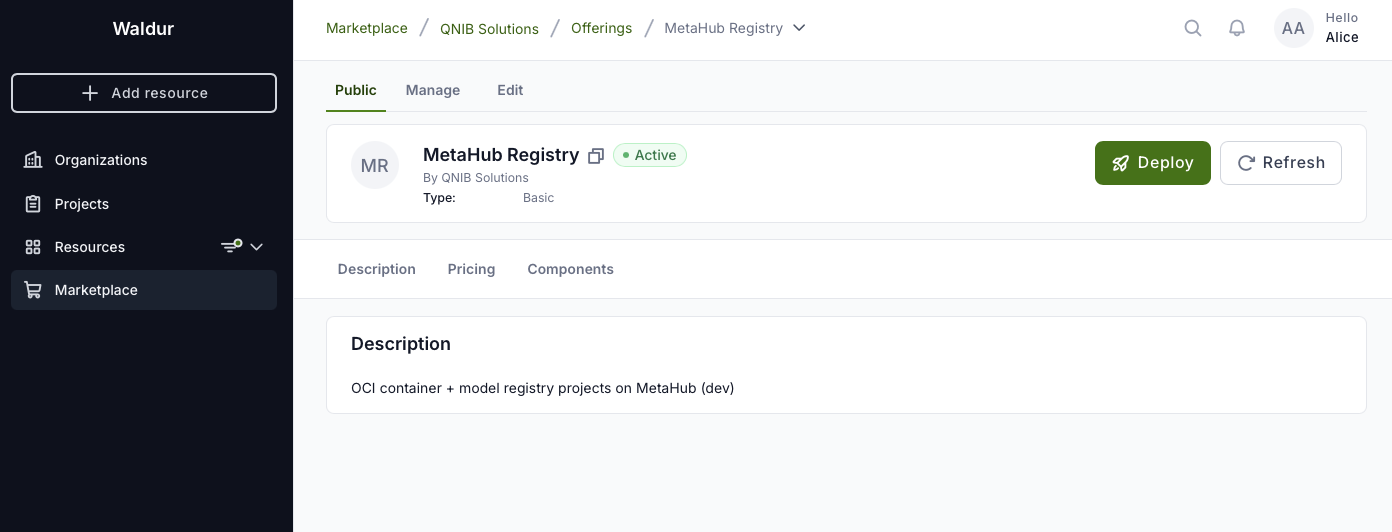
The lifecycle loop
The site-agent automates a small, well-defined loop between Waldur, MetaHub and Authentik:
| Mode | Trigger | What happens |
|---|---|---|
| order_process | a create/update/terminate order | upsert the MetaHub project <org>/<project> with the ordered quota + visibility; delete on terminate |
| report | periodic | read MetaHub usage and post it as the Waldur storage component usage |
| membership_sync | project membership change | reconcile project members into the namespace's Authentik groups (add and remove) |
1. Order → provision
Ordering the offering sets the storage quota (in GB). On approval the site-agent provisions the namespace and applies the quota — idempotently, so a repeat order for an already-provisioned namespace just re-asserts quota/visibility rather than minting a second namespace (≤ 1 registry namespace per Waldur project).
Under the hood the agent calls the MetaHub admin API:
POST /api/v1/protected/projects
{ "team_slug": "<org>", "project_slug": "<project>", "quota_bytes": <GiB×2^30> }
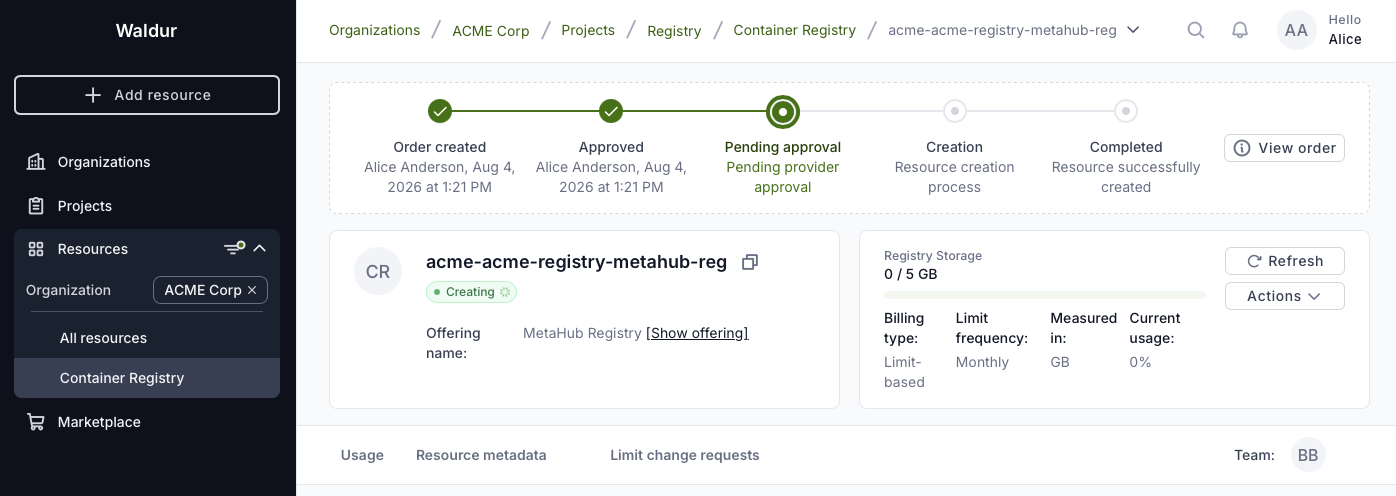
Approval & Provisioning
The order is pending.
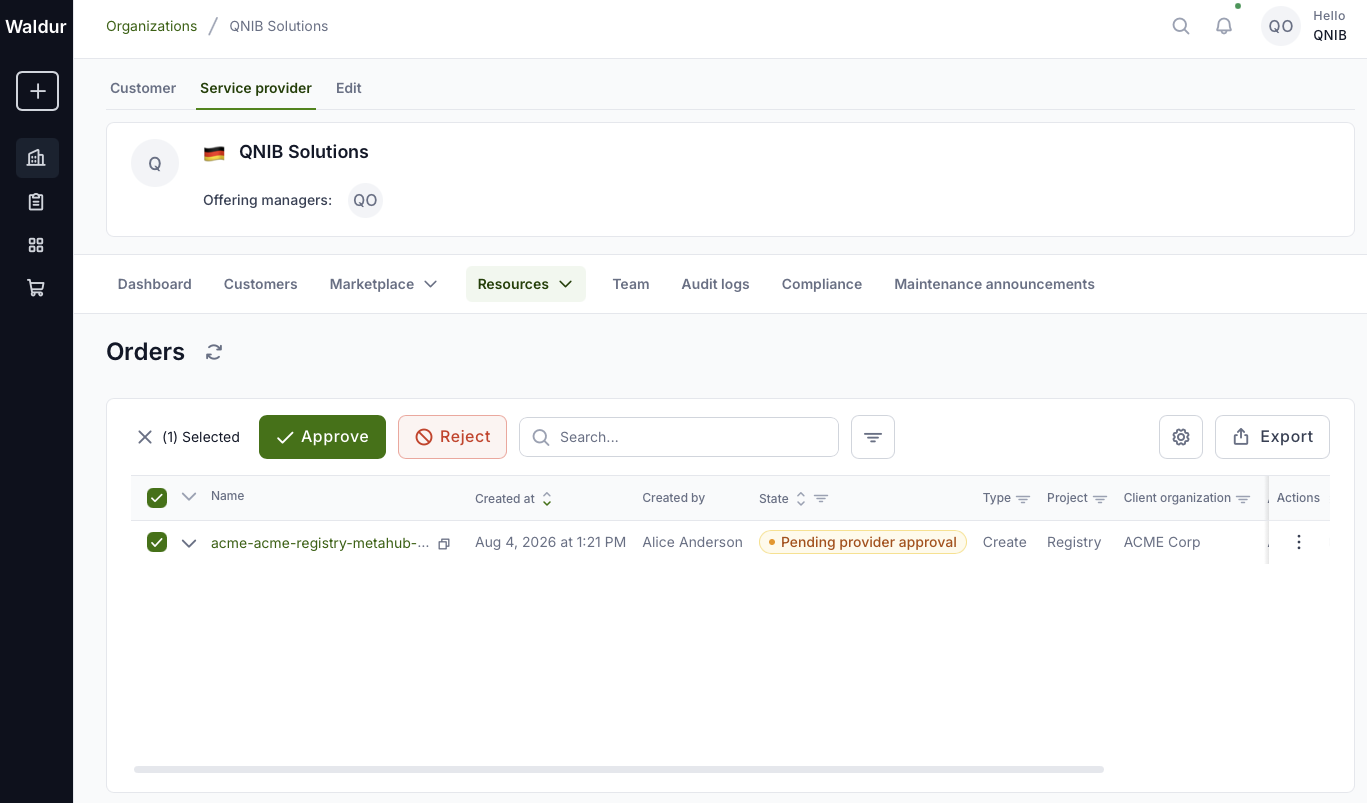
An admin needs to approved the order.
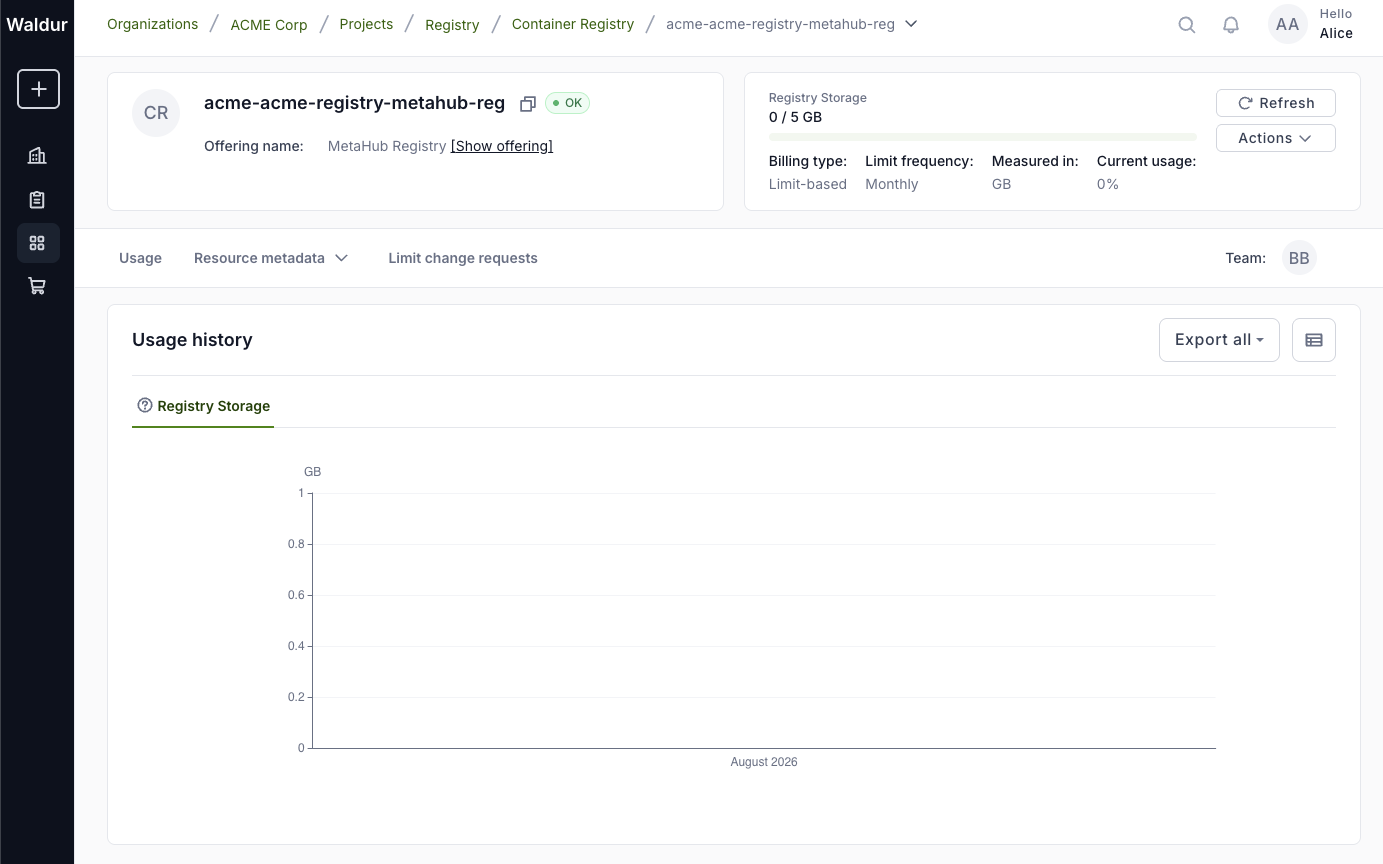
After which it will be deployed (project created and quotas in place).
2. Push & pull
Users authenticate to the registry with their Authentik identity (OIDC) and push or pull under the namespace like any OCI registry:
docker login <registry> -u <user> -p <app-password>
docker push  <registry>/<org>/<project>/<image>:<tag>
Reads and writes are authorized against the project's Authentik groups; the storage consumed counts against the project quota.
Logical, deduplicated storage
Blobs are stored once globally (content-addressed). A project's usage is the sum of the distinct blob sizes reachable from its manifests — so a project is charged fully for what it references, while identical bytes shared across projects are physically stored a single time.
3. Quota & usage
Each project has a quota_bytes budget; a push that would take the project's logical
usage over quota is rejected. Current usage is read from the admin API:
GET /api/v1/protected/projects/<org>/<project>/usage
→ { "usage_bytes": 4092947, "quota_bytes": 107374182400 }
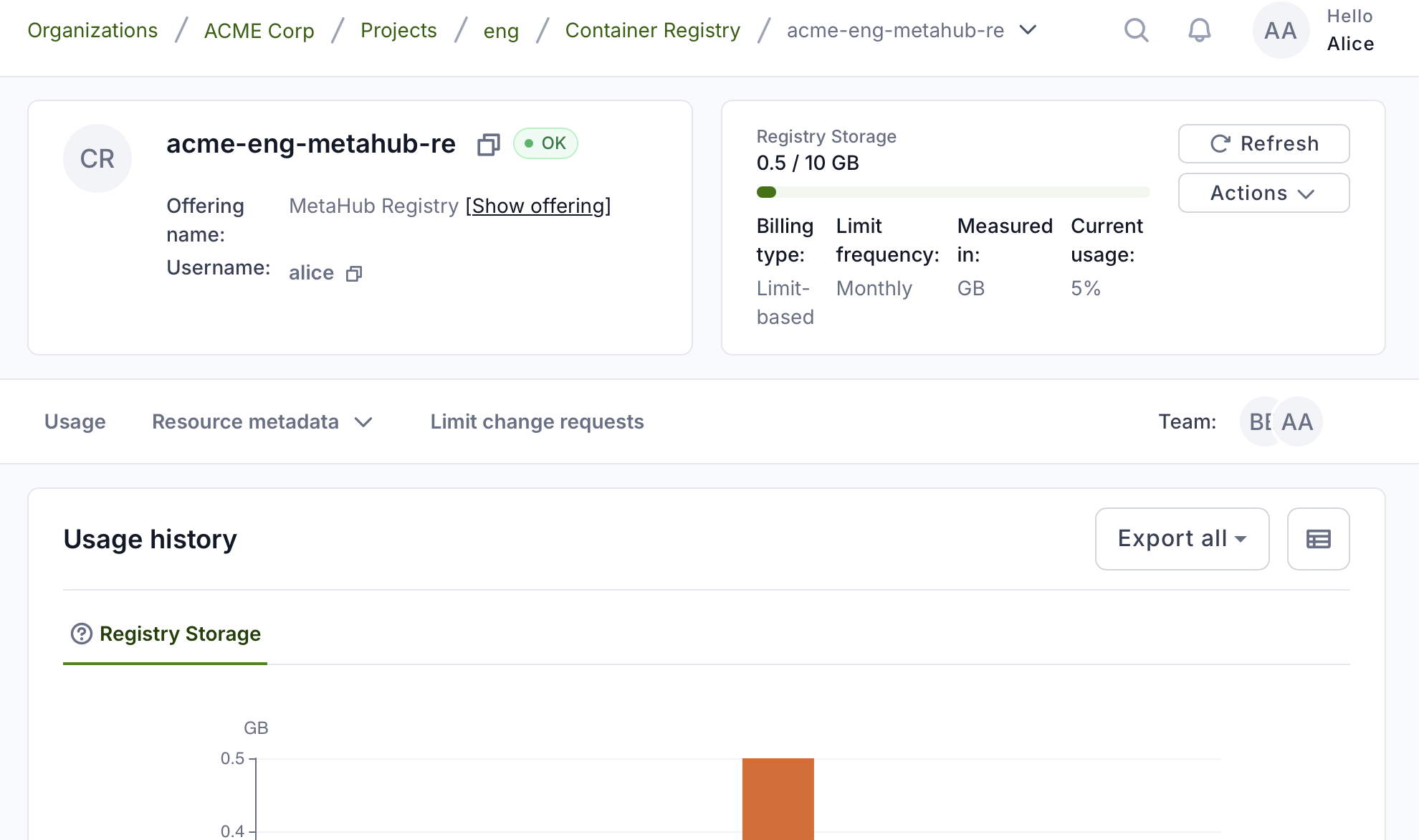
The report mode converts usage bytes → GB (2 decimals) and posts it to Waldur, where
it appears on the resource as current_usages / limit_usage for the storage
component — closing the accounting loop.
Automation: the site-agent
A dedicated waldur-site-agent backend (metahub) runs the loop above on a schedule:
order_process (provision + quota + visibility), report (usage → Waldur, including
the per-user breakdown), and membership_sync (Waldur members → Authentik groups).
MetaHub itself needs nothing extra for membership — it reads the groups claim from
the OIDC token; the agent owns group lifecycle in Authentik.