Model Injection
MetaHub can deliver a large AI model — a multi-gigabyte GGUF file — as an image
layer composed into a runtime image, chosen by the user's VRAM profile.
The model is pushed once as an ORAS artefact, repackaged
into an injectable model-layer image, and attached to a profile as a
manipulation, bound to a runtime collection. Pulling the
model (models/<name>:<quant>) under that profile then composes the runtime
base + model weights + serving config into one image — sized and wired for the
host that asked for it.
This is a model-centric pull: the model is the image. A plain base image pulled under the same profile is served un-injected — see Collections are never model-injected.
This ties the previous capabilities together: an ORAS artefact supplies the payload, and a manipulation overlays it per profile — except the overlaid layer is a model weighing tens of gigabytes rather than a small helper.
The flow
| Step | Who | What |
|---|---|---|
| 1. Push | model author | oras push the GGUF and a per-profile config (each blob tagged by media type) as one artefact |
| 2. Repackage | operator | metahub-admin repackage splits the artefact by media type into a models/<name>-layer and a models/<name>-config image, attaching model/<name> (+ config/<name>) to a VRAM profile, bound to a runtime collection via --runtime |
| 3. Pull | user | docker pull models/<name>:<quant> under the VRAM profile — the runtime, model and its config are composed |
1. Push the model as an artefact
The model arrives like any other ORAS artefact — no special upload path. Because GGUF weights are large, MetaHub accepts the blob as a chunked upload and streams it straight to object storage, so a 10–100 GB push never has to be buffered in memory. Uploads are content-addressed: if a blob whose digest is already in object storage is pushed again — a repeat push, or a re-seed — MetaHub skips the upload, so identical weights are never sent or stored twice.
# Log in to the MetaHub registry
echo hub | oras login -u meta --password-stdin "metahub-registry.org"

# Push the GGUF weights + a per-profile runtime config, each blob by media type
oras push "metahub-registry.org/models/qwen3-8b:q8-kxl" \
  --artifact-type "application/vnd.qnib.model.artifact" \
  ./qwen3-8b-q8_k_xl.gguf \
  ./serve.json:application/vnd.qnib.model.config.v1+json
At this point MetaHub has registered an artefact — you can see it under ORAS Artefacts — but nothing injects it yet. It is inert weights waiting to be wired to a profile.
2. Repackage into an injectable model layer
metahub-admin repackage reads the stored artefact, rewraps its file(s) as an
uncompressed-tar OCI layer, and pushes a small model-layer image
(models/<name>-layer:<quant-tag>). It then creates a model/<name>
manipulation and links it to the target VRAM profile, bound to a runtime
collection (so a model pull knows which base image to compose onto):
metahub-admin --config ./config.yaml repackage \
  --artifact-repo "models/qwen3-8b" \
  --artifact-type "application/vnd.qnib.model.artifact" \
  --name        "qwen3-8b" \
  --quant-tag   "q8-kxl" \
  --profile     "vram#12gb" \
  --runtime     "qnib/llama-server" \
  --registry-url "metahub-registry.org" --registry-user "meta" \
  --registry-pass "hub"
The repackage streams the model a chunk at a time (constant memory, regardless of model size), verifies the content digest end-to-end, and wires the resulting model-layer image into the graph so a pull can resolve it without re-fetching the original artefact.
Note
repackage attaches the model to a profile — it does not rewrite the
runtime image on disk. The runtime blobs stay shared; the model layer is
overlaid per profile at pull time, exactly like a
manipulation. The --runtime flag records which
collection the model composes onto — without it the model has no composition
and a model-centric pull cannot resolve.
3. Pull the model under a VRAM profile
As with every other MetaHub feature, the profile comes from the login credential. First, for reference, pull the model with no model profile — the runtime collection resolves, but no model is composed:
$ echo hub | docker login --password-stdin -u 'meta' metahub-registry.org
Login Succeeded

$ docker pull --platform=linux/amd64 metahub-registry.org/models/qwen3-8b:q8-kxl
$ docker inspect metahub-registry.org/models/qwen3-8b:q8-kxl
"RootFS": {
    "Layers": [
        "sha256:8d78b2117a5b...",   // runtime base layer (resolved from the collection)
        "sha256:7b386a2af9d0..."    // runtime base layer
    ]
}
2 layers — the runtime image alone. Now log in with the vram#12gb VRAM
profile and pull the same model tag:
$ echo hub | docker login --password-stdin -u 'meta/vram#12gb' metahub-registry.org
Login Succeeded

$ docker pull --platform=linux/amd64 metahub-registry.org/models/qwen3-8b:q8-kxl
$ docker inspect metahub-registry.org/models/qwen3-8b:q8-kxl
"RootFS": {
    "Layers": [
        "sha256:8d78b2117a5b...",   // runtime base layer (shared)
        "sha256:7b386a2af9d0...",   // runtime base layer (shared)
        "sha256:c0ffee00model...",  // model layer (qwen3-8b, q8-kxl)
        "sha256:c02f1900conf..."    // config layer (/model/qwen3-8b/config)
    ]
}
Same models/qwen3-8b:q8-kxl tag, but the served image now carries two extra
layers — the model and its config — composed because the login asked for the
vram#12gb profile. The runtime base blobs are untouched and shared; only the
model and config layers are new.
Collections are never model-injected
A model serving manipulation only applies to model-centric pulls
(models/<name>:<quant>). Pulling a plain collection image — the runtime, or
any other base image — under the same VRAM profile serves that image as-is:
the model is not injected.
$ echo hub | docker login --password-stdin -u 'meta/vram#12gb' metahub-registry.org

# A collection pull under the model profile is served un-injected:
$ docker pull --platform=linux/amd64 metahub-registry.org/qnib/llama-server:latest
$ docker inspect metahub-registry.org/qnib/llama-server:latest
"RootFS": {
    "Layers": [
        "sha256:8d78b2117a5b...",   // runtime base layer
        "sha256:7b386a2af9d0..."    // runtime base layer
    ]
}
No model, no config — just the collection image. This keeps the two concepts clean: a collection is an opinionated, profile-filtered image index (no model injection); a model is a runtime image with the model and its config composed as extra layers. Non-model manipulations (see Manipulations) still apply to collection pulls — only the model-serving stack is gated to model-centric pulls.
Why the profile drives it
Sizing a model to the hardware is exactly the kind of user-context decision
MetaHub exists to make. A model/<name> manipulation can carry per-VRAM
variants the same way glow-extended carries per-architecture ones (see
Manipulations → Defaults and variants):
| Login selector | Model layer served | Fits |
|---|---|---|
meta/vram#12gb |
heavily quantized weights | a 12 GB consumer GPU |
meta/vram#128gb |
full-precision weights | a 128 GB data-center GPU |
meta (no VRAM selector) |
none — runtime image alone | any host |
One model tag, one push of the weights, and each host pulls the largest model its VRAM can hold — without the user choosing a quantization by hand.
Serving config, per profile
Weights alone don't serve — the runtime needs a config (model path, context
size, how many layers to offload onto the GPU), and the right config differs per
VRAM tier. That's why the push in step 1 carries a second blob tagged with the
dedicated config media type application/vnd.qnib.model.config.v1+json.
repackage splits the artefact by media type: the GGUF becomes the model
layer, and the config blob becomes a config layer at /model/<name>/config/,
attached to the same VRAM profile as a sibling config/<name> manipulation. A
model pull under the profile then injects both — the model and its config —
and a QNIB_MODEL_CONFIG_DIR=/model/<name>/config env var points a
llama.cpp-style entrypoint at it.
Push one config per profile (vram#12gb, vram#128gb) and each host gets the
config its GPU wants — the publisher writes the exact args; MetaHub only places
the bytes, never guessing them.
What you see in the UI
| Concept | Where it shows up |
|---|---|
| The model | the Models tab — one card per model with its VRAM profiles and image variants (the models/<name>-layer / -config images are kept out of Collections) |
| The source artefact | Artefacts, as models/<name> — linked from the model card via its OCI subject reference |
| The composed layers | expand models/<name> under the VRAM profile — runtime base + the model layer (and the config layer, when pushed) |
| The profile link | open the VRAM profile — its Manipulations section lists model/<name> (and config/<name>) |
Note
The model layer is stored once and shared across every base image that composes it — serving the model for two different profiles does not duplicate the weights in object storage.
Diagram
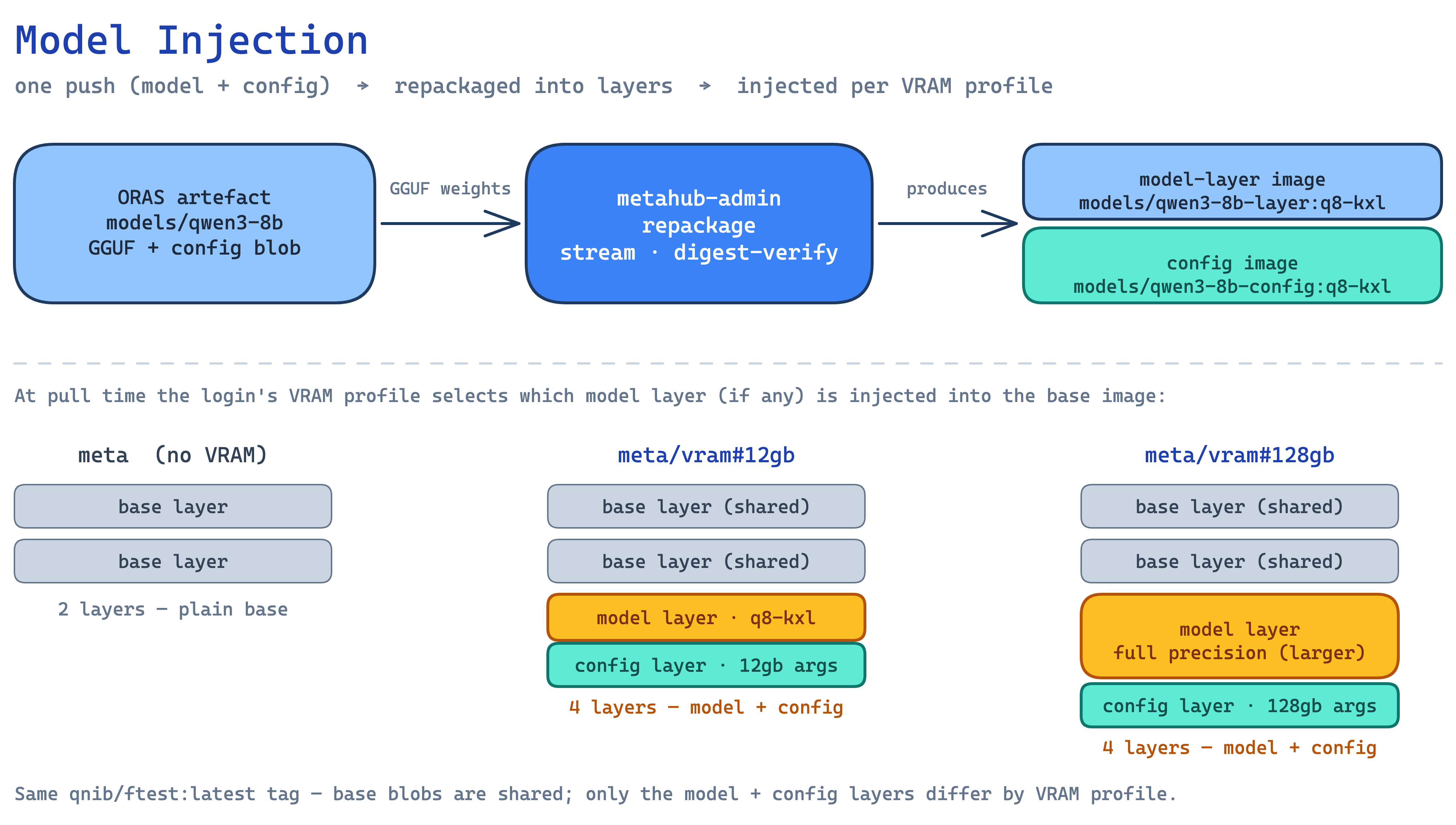
Source: docs/assets/diagrams/model-injection.excalidraw (edit + re-render to update).